KoboldTouch
Independent · Multilingual · Updated Aug 2026

Best E-Ink Tablets of 2026Tested, Ranked & Compared for Reading, Writing and Everything Between

Last updated: August 2026. KoboldTouch is reader-supported and editorially independent, zero paid placements. We buy or borrow every device we rank and score them on a consistent 100-point scale (the KT Score).

11
reviews
0
paid placements
Aug 26
updated

An e-ink tablet replaces the stack of notebooks, the pile of printed PDFs, and, for a lot of people, the tablet that keeps pulling them into email and social feeds. Instead of a glowing LCD, it uses a paper-like electronic-paper display that is easy on the eyes, readable in direct sunlight, and sips battery so gently that a single charge lasts days or weeks. In 2026 the category has never been better: the writing feel rivals real paper, color e-ink has finally matured, and there is a genuinely great device at almost every price and screen size.

But that also makes choosing harder. reMarkable, Boox, Supernote, Amazon Kindle, Kobo and newcomers like Viwoods all take very different philosophies, locked-down and distraction-free versus open Android with the Google Play Store; pure note-taker versus do-everything hybrid; premium color versus affordable monochrome. This guide cuts through it. We tested the current lineup, cross-checked our verdicts against thousands of real owner reviews on Amazon and long-running threads on Reddit's r/eink, and boiled it down to clear picks by use case, an at-a-glance comparison table, an honest buying guide, and answers to the questions people actually ask.

At a glance

Short on time? Here are our category winners for 2026. Every pick is explained in depth further down, and full specs are in the comparison table.

Best overall01
reMarkable Paper Pro

The most refined write-and-read experience, now with color and a frontlight

11.8" color$579+
Best for pure note-taking02
Supernote Manta (A5 X2)

Unbeatable writing feel, deep organization, no subscription, repairable

10.7" mono~$499
Best value all-rounder03
Boox Go 10.3 (Gen II)

Open Android + Play Store flexibility at a fair price

10.3" mono$379–$449
Best color e-ink tablet04
Boox Note Air5 C

The most usable color hybrid for notes, PDFs, manga and light apps

10.3" color$529
Best for Kindle / Amazon readers05
Amazon Kindle Scribe (2024)

Sharpest text, write inside your Kindle books, no learning curve

10.2" mono$399+
Best for readers who annotate & borrow library books06
Kobo Elipsa 2E

OverDrive library borrowing, open formats, no subscription

10.3" mono$399
Best large screen07
Boox Note Max

A4-sized 300 PPI canvas for PDFs, music and technical work

13.3" mono$599
Best pocket-sized08
Boox Palma 2

A phone-shaped e-reader you can carry everywhere

6.13" mono$279
Best budget note-taker09
Supernote Nomad (A6 X2)

The Supernote experience in a compact, affordable body

7.8" mono~$299
Best premium distraction-free writer10
reMarkable 2

Still the benchmark for focused, paper-like monochrome writing

10.3" mono$379+
Rising star (best AI note tools)11
Viwoods AI Paper

Android openness plus genuinely useful on-device AI, case & pen included

10.65" mono$469–$549
How we score

How we tested and scored (and why you can trust this)

Rankings are only useful if you know how they were made. Every device here is scored on the KT Score, a 0–100 rating built from four weighted pillars:

Writing experience (30%): latency, friction/texture, palm rejection, pen quality, and how "paper-like" it actually feels.
Reading & display (25%): resolution and sharpness, contrast, color quality (where applicable), frontlight evenness, and refresh behavior.
Software & ecosystem (25%): note app depth, organization, handwriting-to-text, file/format support, app openness, and sync.
Value & ownership (20%): price for what you get, subscription/hidden costs, repairability, update longevity, and support reputation.

Because your opinion of a device shouldn't rest on one reviewer, we pressure-tested our conclusions against the wider community. We read current owner reviews on Amazon.com and mined long-running discussions on Reddit's r/eink and dedicated e-reader forums, then flagged where real-world sentiment agrees or disagrees with the spec sheet. Those "what real owners say" notes appear in each review below.

Compare

E-ink tablet comparison table (2026)

The full field at a glance. "Open Android" means you can install the Google Play Store and apps like Kindle, Kobo, OneNote, Google Drive and Obsidian; "Closed" means a curated, distraction-free system.

11.8"Yes (color)Closed$579+
10.7"NoClosed (open-ish)~$499
Boox Note Air5 C 88
10.3"Yes (Kaleido)Open Android 13$529
10.3"NoOpen Android$379–$449
10.2"NoClosed (Kindle)$399+
10.3"NoClosed (Kobo)$399
10.3"NoClosed$379+
Boox Note Max 86
13.3"NoOpen Android 13$599
Viwoods AI Paper 84
10.65"NoOpen Android 13$469–$549
7.8"NoClosed (open-ish)~$299
6.13"NoOpen Android$279

What is an e-ink tablet? (And who should, and shouldn't, buy one)

An e-ink tablet is a device built around an electronic-paper display made of microscopic charged capsules that flip black or white (or, in color panels, sit behind a color filter). Unlike an LCD or OLED screen, e-ink is reflective: it uses ambient light like real paper rather than blasting light at your eyes, and it only draws power when the image changes. That's why the text looks calm and matte, why it stays perfectly readable on a sunny patio, and why battery life is measured in days or weeks instead of hours.

There are three overlapping families:

  • Writing tablets / digital notebooks (reMarkable, Supernote, Boox Note series, Viwoods): large screens with a stylus for handwriting, sketching and PDF markup.
  • Reading-first e-readers (Kindle, Kobo, Boox Palma): optimized for books; some now add a pen for light notes.
  • Hybrids (most Boox devices, Kindle Scribe, Kobo Elipsa): read, write and, on Android models, run apps.
  • You'll love an e-ink tablet if you want to take handwritten notes that are searchable and backed up, read for hours without eye strain, mark up PDFs and documents, or deliberately step away from the distractions of a full tablet. You should probably skip one if your work depends on fast, full-color video, photo editing, spreadsheets, or responsive web apps, e-ink refreshes slowly and colors are muted. For those jobs, an iPad or Android tablet with a matte screen protector is the better tool, and we say so honestly below.

    How to choose an e-ink tablet: the buying guide

    Screen size

    Most writing tablets cluster around 10.3"–11.8", which mimics a standard notebook or A5 page, the sweet spot for notes plus most PDFs. Step up to 13.3" (Boox Note Max, Boox Tab X C) if you read full-size A4 PDFs, sheet music, or engineering drawings, or want a laptop-like canvas; the trade-off is weight and portability. Drop to 7"–8" (Supernote Nomad, Kobo Sage) or 6" (Boox Palma, Kindle) for one-handed reading and grab-and-go notes.

    Monochrome vs. color

    Monochrome e-ink is sharper (often 300 PPI), higher-contrast, cheaper and better for pure text and handwriting. Color e-ink uses one of two technologies: Kaleido 3 (used in most Boox color models) layers a color filter over the panel, color resolution is lower (~150 PPI) and slightly muted, but it's responsive and affordable; Gallery-class color (as on the reMarkable Paper Pro) shifts pigments for richer, more saturated color at the cost of slower full-color refreshes. Choose color only if you genuinely need it, highlighting, manga, kids' books, charts and scientific figures. If you mostly write and read text, monochrome looks better and costs less.

    Frontlight

    A frontlight lets you read and write in the dark and is standard on e-readers. Notably, the reMarkable 2 and many Boox "Go/Note" base models ship without one, while the reMarkable Paper Pro, Kindle Scribe, Kobo devices, and Boox "Lumi" variants include it. If you read in bed or take notes in dim rooms, prioritize a frontlight, several owners specifically regret buying a no-light model.

    Writing feel, latency and the pen

    This is the make-or-break for note-takers. Look for low latency (how quickly ink appears under the pen), a textured writing surface that adds paper-like friction, and a comfortable stylus. Supernote's soft, self-recovering film and ceramic nib (no glass, no nibs to replace) and reMarkable's low-latency response are the community favorites. Check whether the pen is included, reMarkable sells its Marker separately, which adds to the true price, and whether replacement nibs are a recurring cost.

    Software: locked-down or open Android

    This is the biggest philosophical fork. Closed systems (reMarkable, Supernote, Kindle, Kobo) are curated, stable and distraction-free, with polished native note apps, but you can't just install any app. Open Android systems (Boox, Viwoods) let you side-load or download the Google Play Store and run Kindle, Kobo, Libby, OneNote, Google Drive, Obsidian, Notion and more on one device. Open means flexible; closed means focused. Reddit's r/eink summarizes it well: Boox is the "solid all-rounder," reMarkable is the "Apple-like" experience, and Supernote is "for those who write."

    Ecosystem, file support and sync

    If you live in Amazon's ecosystem, a Kindle Scribe reads your existing library instantly. If you borrow from your public library, Kobo's built-in OverDrive support is a killer feature. Android tablets read practically any format (EPUB, PDF, CBZ/CBR, DOCX) through apps. Check how notes leave the device: cloud apps, email, WebDAV, or integrations like Supernote's Obsidian export.

    Subscriptions and hidden costs

    Factor the total cost. reMarkable's Connect plan (about $2.99/month) unlocks unlimited cloud sync and some handwriting features; the pen and folio are extra. Supernote, Boox, Kobo and Kindle notebooks work with no mandatory subscription. A "cheaper" tablet can cost more once you add a pen, case and a monthly plan.

    Durability, repairability and privacy

    Supernote stands out for a repairable design with a replaceable battery and upgradable board, a real plus for longevity. Some owners raise two recurring concerns worth knowing: Boox devices can ship on older Android versions (a longevity/security consideration for workplace use), and privacy-minded users note that Boox and other China-based brands sync through overseas servers. None are dealbreakers for most people, but they're fair to weigh.

    The best e-ink tablets of 2026, reviewed

    Best overall

    11.8" color e-ink · frontlight · closed OS · ~$579 (device) · KT Score 92

    The Paper Pro is the device that finally makes a color e-ink notebook feel premium. It pairs an 11.8-inch color display with a frontlight, the two things the beloved reMarkable 2 lacked, keeps the industry-leading low-latency writing feel, and wraps it in a 5.1mm chassis that's almost absurdly thin. If you want one device that nails the core write-and-read experience without fiddling, this is it.

    Pros
    • +best-in-class, near-zero-latency writing
    • +genuinely useful color
    • +excellent frontlight
    • +gorgeous hardware
    • +polished, focused software and cross-device apps.
    Cons
    • expensive once you add the Marker and folio
    • deliberately limited (no app store, browser or clock)
    • typed-text editing is clunky
    • some navigation and file transfers feel sluggish
    • full cloud features lean on the optional Connect subscription.
    What owners say: Reviewers and redditors consistently rank its writing feel at the very top, one owner called it a tie with "an iPad Air plus a matte screen protector," praising the distraction-free ethos while noting it's heavier than an iPad. The most common gripe is value: you're paying a premium for restraint.

    Buy it if you want the best all-round writing-and-reading device and will pay for polish. Skip it if you want apps, a bargain, or a spreadsheet-friendly workhorse.

    Check price
    Best for pure note-taking

    10.7" monochrome (flexible, 300 PPI) · no frontlight · ~$499 · KT Score 91

    If writing is the whole point, the Supernote Manta is the connoisseur's choice. Its FeelWrite soft-film surface and ceramic nib deliver a quiet, grippy, genuinely paper-like feel, and because the nib is ceramic, there are no nibs to replace and no glass layer between you and the "paper." The note software is deep: powerful organization, keyword search, real-time handwriting recognition, and slick Obsidian/cloud export. There's no mandatory subscription, and the design is repairable with a replaceable battery.

    Pros
    • +superb writing feel
    • +excellent organization and linking
    • +ceramic nib (no consumables, no glass)
    • +no subscription
    • +repairable, upgradable, long-life design
    • +strong, responsive maker (Ratta) with meaningful updates.
    Cons
    • no frontlight
    • monochrome only
    • the software, while much improved, still feels less "instant" than reMarkable to some
    • handwriting recognition can struggle with messy writing or acronyms.
    What owners say: Supernote inspires unusual loyalty, r/eink users describe themselves as "Supernote fanbois," praise the organization features and Obsidian integration, and love that "the ceramic nibs never run out." The recurring caution from switchers is that early Supernotes had clunky sync and a learning curve; recent models and firmware have largely addressed this.

    Buy it if you write constantly and value organization, repairability and no fees. Skip it if you need color, a frontlight, or Android apps.

    Check price
    Best value all-rounder

    10.3" monochrome · frontlight on "Lumi" model · open Android · $379–$449 · KT Score 88

    The Boox Go 10.3 is the device r/eink recommends more than any other to people who want one tablet to do everything without overspending. It's a thin, light reMarkable-style slate, but running open Android, so you can install the Google Play Store and use Kindle, Kobo, OneNote, Google Drive, Obsidian and more directly on the device. The writing feel is very good, and the newer Lumi variant finally adds a frontlight.

    Pros
    • +outstanding flexibility (any reading/notes app)
    • +strong writing feel
    • +light and thin
    • +excellent value versus Kindle Scribe and reMarkable
    • +great for syncing handwritten notes to OneNote.
    Cons
    • base model has no frontlight (pay up for Lumi)
    • monochrome only
    • Boox's software has a learning curve and occasional quirks
    • some units ship on older Android versions, which matters for workplace security policies.
    What owners say: Owners rave that "OneNote runs flawlessly" and battery holds up even with Wi-Fi on; one professional uses it instead of a company-issued iPad. The standout complaint is Android longevity, one buyer was frustrated their Go 10.3 was stuck on an older Android release less than a year after purchase.

    Buy it if you want maximum app flexibility for the money. Skip it if you want a curated, worry-free closed system or guaranteed long OS support.

    Check price
    04 Boox Note Air5 C
    Best color e-ink tablet

    10.3" Kaleido color · frontlight · open Android 13 · $529 · KT Score 88

    The Note Air5 C is the most usable color hybrid you can buy. It brings Kaleido color, a frontlight, Boox's Super Refresh anti-ghosting tech, and full Android 13 with the Play Store to a 10.3-inch body, so it reads manga and color PDFs, takes color-coded notes, and runs your apps. For anyone who wants color and versatility in one device, this is the pick.

    Pros
    • +among the best color note-takers
    • +genuine app flexibility
    • +color adds real value for highlighting, manga and scientific figures
    • +strong performance
    • +frontlight included.
    Cons
    • color e-ink is dimmer and grainier than monochrome and roughly half the resolution
    • you'll often want the frontlight on, which costs battery
    • occasional Google Play integrity issues can block some banking/secure apps
    • stylus magnet placement can get in the way.
    What owners say: A representative r/eink owner of the color Note Air line: "Color screen, very responsive while note taking, loving reading manga, books, sketching, and Google Play Store is perfect." The most common critique across reviews is that color e-ink still looks muted next to monochrome, so buy it for the color, not despite it.

    Buy it if you want one color device for notes, reading and apps. Skip it if you prioritize the crispest text or the longest battery.

    Check price
    Best for Kindle / Amazon readers

    10.2" monochrome, 300 PPI · frontlight · closed (Kindle) OS · $399+ · KT Score 86

    If your books already live in Amazon's ecosystem, the Kindle Scribe is the frictionless choice. Text is razor-sharp at 300 PPI, the frontlight is excellent, and recent updates let you write inside your Kindle books with the Active Canvas feature plus AI note summaries. There's no learning curve and no subscription for notes.

    Pros
    • +sharpest, most refined reading experience
    • +write-in-book annotation
    • +strong handwriting recognition
    • +useful AI summaries
    • +instant access to your Kindle library.
    Cons
    • notebook organization and templates lag behind reMarkable, Supernote and Goodnotes
    • closed ecosystem (no EPUB natively, no third-party apps)
    • price has crept upward
    • cloud AI features can be slow and battery-hungry.
    What owners say: Owners repeatedly call it the "best writing experience overall" among mainstream devices and love writing in their books, but the near-universal wish is better notebook organization and templates: "if they'd update the Scribe's organization, it would be the clear winner."

    Buy it if you're an Amazon reader who wants light note-taking. Skip it if you need serious notebook organization or open formats.

    Check price
    Best for readers who annotate and borrow library books

    10.3" monochrome · frontlight · closed (Kobo) OS · $399 · KT Score 85

    The Elipsa 2E is the reader's writing tablet. It combines a capable 10.3-inch note experience (handwriting-to-text, an equation solver, PDF markup) with Kobo's biggest advantages: built-in OverDrive library borrowing, broad open-format support (EPUB, PDF), Dropbox and Google Drive integration, and, crucially, no subscription. The body is made largely from recycled plastic.

    Pros
    • +borrow library books directly
    • +open formats and cloud services
    • +solid note tools
    • +no fees
    • +eco-conscious build.
    Cons
    • pricier once you realize the SleepCover isn't bundled
    • design feels dated and plasticky next to the Scribe
    • page refresh and writing are a touch slower than Kindle
    • battery trails the Scribe.
    What owners say: Reviewers highlight the combination of strong reading, library borrowing and note-taking with no subscription as the reason to pick it over a Kindle Scribe; the common grumbles are the extra-cost cover and a slightly slower, less premium feel.

    Buy it if you're a heavy library borrower who also wants to annotate. Skip it if you want the fastest, most premium writing.

    Check price
    Best premium distraction-free writer

    10.3" monochrome · no frontlight · closed OS · $379+ · KT Score 85

    The device that defined the modern category is still one of the best. The reMarkable 2 offers a sublime, near-zero-latency monochrome writing feel in a beautifully thin, distraction-free package. If color and a frontlight don't matter to you, it remains the purest "digital paper" and usually costs less than the Paper Pro.

    Pros
    • +exceptional paper-like writing
    • +ultra-thin and premium
    • +zero distractions
    • +excellent cross-device sync app
    • +long battery life.
    Cons
    • no frontlight (can't write or read in the dark)
    • monochrome only
    • the Marker and folio are extra
    • some cloud/handwriting features sit behind the Connect subscription
    • limited app ecosystem.
    What owners say: Long-time owners praise the "Apple-like" polish and focus; the recurring criticisms are the subscription for full cloud features and the lack of a frontlight. Many still recommend it over the Paper Pro for buyers who don't need color.

    Buy it if you want the classic, focused writing experience for less. Skip it if you need a frontlight, color or apps.

    Check price
    08 Boox Note Max
    Best large screen

    13.3" monochrome, Carta 1300, 300 PPI · no frontlight · open Android 13 · $599 · KT Score 86

    When a 10-inch page isn't enough, the Note Max delivers an A4-sized, 13.3-inch, 300 PPI monochrome canvas in a remarkably thin (4.6mm) body. It's the device for reading full-size PDFs, sheet music, textbooks and technical drawings without endless pinch-zooming, and open Android means you can run whatever apps you like.

    Pros
    • +huge, sharp 300 PPI display
    • +excellent for A4 PDFs, music and technical documents
    • +open Android flexibility
    • +thin for its size.
    Cons
    • no frontlight
    • large and heavier (~615g)
    • expensive
    • big screens exaggerate any e-ink refresh lag.
    What owners say: r/eink users cross-shop it against the Boox Go 10.3 as the "bigger sibling" and recommend it specifically for people who read large-format documents; the main caution is size/weight and the missing frontlight.

    Buy it if you work with full-size documents. Skip it if you want something pocketable or lit.

    Check price
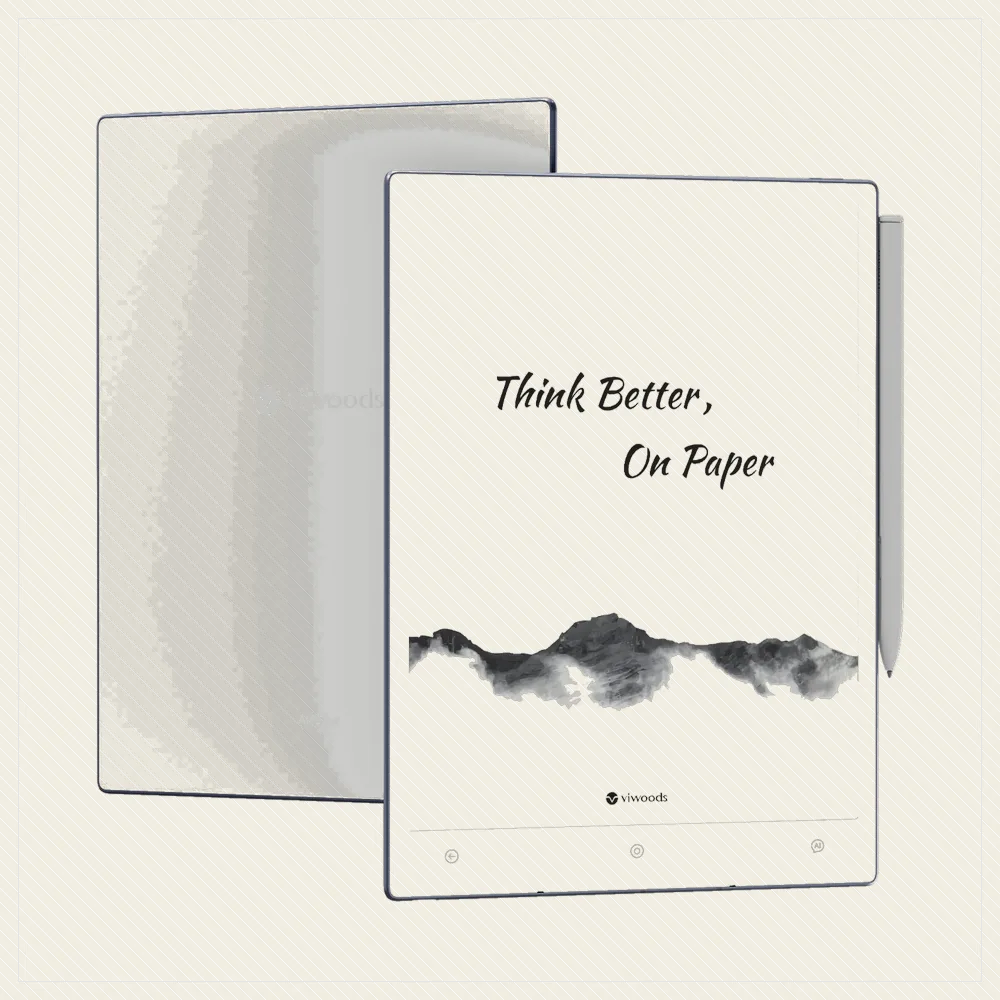
    09 Viwoods AI Paper
    Rising star / best AI note tools

    10.65" monochrome, Carta 1300 · no frontlight · open Android 13 · $469–$549 · KT Score 84

    Viwoods is the newcomer that r/eink and forum reviewers keep calling "the sleeper of the bunch." The AI Paper offers open Android with the Play Store, a ceramic-tip stylus, and genuinely useful built-in AI (note summarization, smart search, knowledge-base organization), and it includes the stylus and a slim case in the box, which softens the price.

    Pros
    • +strong value (pen + case included)
    • +open Android
    • +useful on-device AI features
    • +good writing feel
    • +no subscription.
    Cons
    • newer brand with a smaller track record
    • no frontlight
    • less raw performance than top-tier Boox
    • some owners have raised concerns about screen durability and repair turnaround, so buy from a seller with a solid return policy.
    What owners say: Forum comparisons rank it surprisingly close to the Note Max and Supernote Manta for the money, and buyers appreciate the included accessories. The main hesitation is long-term reliability and support, given the brand's youth.

    Buy it if you want Android flexibility plus AI tools at a keen price. Skip it if you want a proven long-term track record.

    Check price
    Best budget note-taker

    7.8" monochrome · no frontlight · closed (open-ish) OS · ~$299 · KT Score 85

    The Nomad brings the acclaimed Supernote writing feel, organization and ceramic-nib durability to a compact, one-handed 7.8-inch body at a much friendlier price. It's the pick for people who want to carry a real notebook replacement everywhere without an A5 footprint.

    Pros
    • +superb writing feel and organization in a small package
    • +repairable and subscription-free
    • +excellent value
    • +very portable.
    Cons
    • small screen limits PDF work
    • no frontlight
    • monochrome
    • same slight software learning curve as the Manta.
    What owners say: Owners describe themselves as "beyond thrilled" with the Nomad for note-taking and reading (it runs the Kindle app), and several recommend it as a cheaper alternative to a Boox Go 10.3 for people whose priority is writing.

    Buy it if you want the Supernote experience, compact and affordable. Skip it if you need a large canvas or a frontlight.

    Check price
    Best pocket-sized

    6.13" monochrome, 300 PPI · frontlight · open Android · $279 · KT Score 84

    The Palma 2 is the cult favorite that looks like a phone but is a pure, distraction-free e-ink reader. It slips into a pocket, runs open Android with the Play Store (Kindle, Libby, Kobo, whatever you like), and is the best way to always have a book, without the temptation of a smartphone. A Palma 2 Pro variant adds color, handwriting and cellular for more money.

    Pros
    • +ultra-portable, one-handed reading
    • +open Android + Play Store
    • +excellent for commuters and travelers
    • +a distraction-free "dumb phone" for books.
    Cons
    • not a note-taker (no stylus on the standard model)
    • pricey for an e-reader
    • Boox software can overwhelm casual users
    • no waterproofing.
    What owners say: Fans love it as the "always have a book" device and as a deliberate phone-replacement for reading; the main criticism is that it's expensive for what is essentially a pocket reader.

    Buy it if you want a book in your pocket everywhere. Skip it if you need to handwrite or want a bargain reader.

    Check price

    Which e-ink tablet should you buy? Pick by use case

    For students: You want handwriting-to-text, PDF markup, cloud sync and a fair price. The Boox Go 10.3 (apps, OneNote/Drive sync) or a Supernote Nomad/Manta (best writing, no fees) are ideal; if you're deep in Kindle, the Kindle Scribe works too. Many schools now allow e-ink devices even where phones are banned, confirm with yours first.
    For professionals who annotate documents: Prioritize a big, sharp screen and PDF tools, Boox Note Max (13.3") for full-size docs, or the reMarkable Paper Pro for polish and color markup.
    For avid readers: If you buy books, a Kindle or Kindle Scribe; if you borrow from libraries, a Kobo (Elipsa 2E, Libra Colour, or Sage); if you want any app, a Boox Palma 2 or Go 7.
    For minimalist writers: The reMarkable 2 or Supernote Manta, pure, distraction-free, paper-like.
    For sketchers and manga fans: Go color and open: Boox Note Air5 C or the larger Boox Tab X C.
    For travelers and commuters: Boox Palma 2 (pocket) or Supernote Nomad (compact notes).

    E-ink tablet vs. iPad: the honest comparison

    We won't pretend e-ink beats an iPad at everything. An iPad (or Android tablet) with a matte "paper-feel" screen protector gives you a similar writing feel plus a fast full-color screen, Goodnotes and Notability, video, and every app, and some reviewers rate an iPad Air with a matte protector on par with the reMarkable Paper Pro for writing. What the iPad can't match is e-ink's calm, glare-free, eye-friendly display, its multi-day battery life, its sunlight readability, and, maybe most important, its focus. The whole appeal of e-ink is doing one thing (reading or writing) without notifications, ads and the pull of the internet. If you want a do-everything device, buy the iPad. If you want to read and think without distraction, buy the e-ink tablet.

    Things to know before you buy (the honest caveats)

    Refresh and ghosting: All e-ink refreshes more slowly than LCD and can leave faint "ghost" images; modern anti-ghosting tech (Boox BSR, Super Refresh) helps a lot, but scrolling web pages or watching motion is still a compromise.
    Color is muted: Even the best color e-ink is dimmer and lower-resolution than a phone screen. Buy color only if you need it.
    Subscriptions and accessories: Check whether the pen and case are included and whether cloud features need a plan, these change the real price.
    Android version & app quirks: Some Boox/Android e-ink devices ship on older Android or occasionally fail Google Play integrity checks, which can block certain secure apps. Some Android note apps also run slowly on e-ink, test your must-have apps.
    Privacy: Several popular brands are China-based and sync through overseas servers; if that matters to you, favor a closed system or manage sync manually.

    Frequently asked questions

    What is the best e-ink tablet on the market?

    For most people in 2026, the reMarkable Paper Pro is the best all-round e-ink tablet thanks to its outstanding writing feel, color display and frontlight. If your priority is pure note-taking without fees, the Supernote Manta is our top pick; if you want app flexibility for less, the Boox Go 10.3; and if you're an Amazon reader, the Kindle Scribe. The truthful answer, echoed across r/eink, is that there's no single "best", only the best for your needs.

    Are e-ink writing tablets worth it?

    Yes, if you regularly take handwritten notes, mark up documents, or read a lot and want to reduce eye strain and screen distraction. The eye comfort, sunlight readability, multi-day battery and focus are genuinely transformative for the right person. They're not worth it if you mainly need fast color apps, video or spreadsheets; a regular tablet is better for that.

    Which e-ink tablet feels most like paper?

    The community consensus points to the Supernote (soft self-recovering film with a ceramic nib and no glass layer) and the reMarkable line (very low latency with a textured surface) as the two most paper-like writing experiences. Boox and Viwoods are close behind, and a matte screen protector on an iPad gets surprisingly near.

    What is the best e-ink tablet for reading ebooks?

    For buying books, a Kindle (Paperwhite for pure reading, Scribe if you also want to write). For borrowing library books, a Kobo with built-in OverDrive. For reading any format and any app in your pocket, a Boox Palma 2.

    What are the disadvantages of e-ink?

    Slower screen refresh (poor for video and fast scrolling), possible faint ghosting, muted and lower-resolution color, higher price-per-inch than LCD, and, on open Android models, occasional software quirks. E-ink trades speed and vibrance for eye comfort, battery life and focus.

    Do e-ink tablets require a subscription?

    Most don't. Supernote, Boox, Kobo, Viwoods and Kindle notebooks work with no mandatory subscription. reMarkable's Connect plan (about $2.99/month) is optional and unlocks unlimited cloud sync and some handwriting features, the device still works without it.

    Can you use the Kindle app on an e-ink tablet?

    Yes, on open Android devices (Boox, Viwoods) you can install the Kindle app from the Google Play Store and read your Amazon library right alongside your notes. Closed systems (reMarkable, Supernote) can't run the Kindle app; on a Kindle Scribe your Amazon library is of course native.

    Which is the best e-ink tablet to buy in 2026?

    Buy the reMarkable Paper Pro for the best overall experience, the Supernote Manta for note-taking, the Boox Go 10.3 or Note Air5 C for flexible Android value, the Kindle Scribe for Amazon readers, or the Boox Palma 2 for pocket reading. Match the device to how you'll actually use it, that's what the winners above are organized around.

    Final verdict

    The e-ink category in 2026 is genuinely excellent, and the "right" tablet depends on whether you're a writer, a reader, or someone who wants to do a bit of everything. If we had to hand one device to a friend, it would be the reMarkable Paper Pro for its all-round polish, but a dedicated note-taker will be happier with a Supernote Manta, a value-seeker with a Boox Go 10.3, an Amazon reader with a Kindle Scribe, and a library lover with a Kobo Elipsa 2E. Whatever you pick, an e-ink tablet buys you something a faster, brighter screen can't: calm, focus, and a reason to look up from the feed.